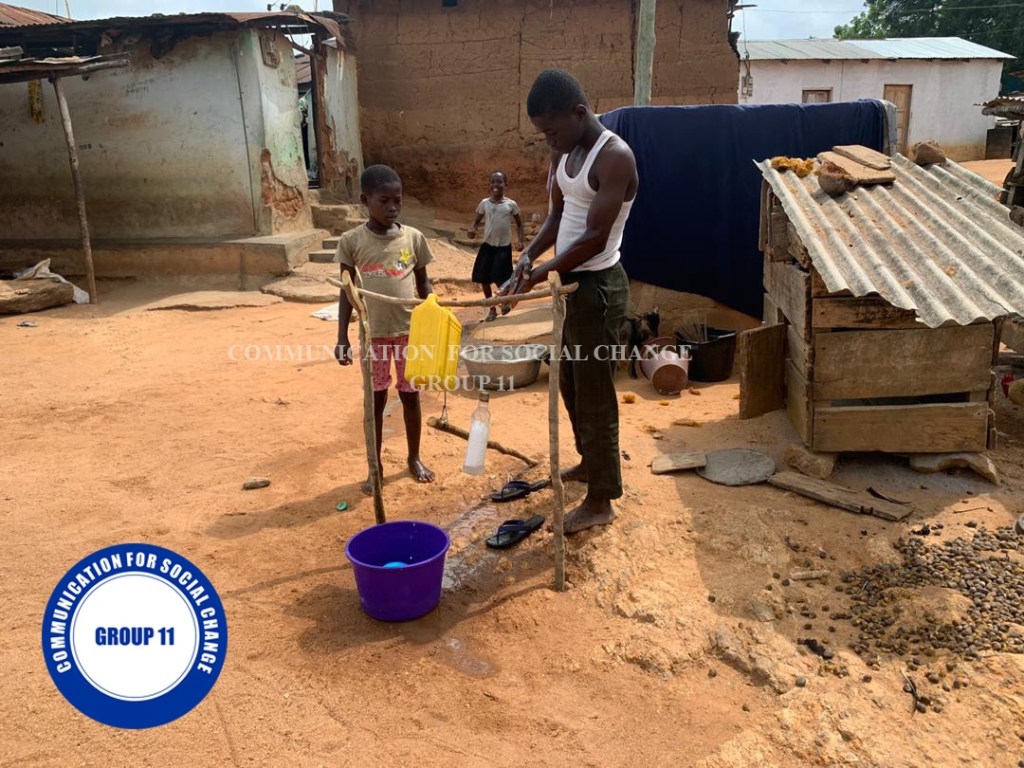
October 15 every year has been set aside by the United Nations to observe as global hand washing day due to the significant roles this behavioural activity plays. The theme for this year’s global hand washing day is Hand Hygiene for All, calling for all of society to achieve universal hand hygiene now and for the future.
COVID-19 pandemic made the world to know that the only way to prevent the spread of infections was hand washing with soap and wearing of face mask. The public as well as institutions adopted the new normal (that’s hand washing under running water with soap). Veronica buckets, soap and disposable tissues were easily seen at vantage points. As the COVID-19 cases in Ghana gradually going down, most people and institutions have disregarded the hand hygiene protocol.
Findings through personal observations were that one woman complained that she’s tired of washing her hands, and that what type of disease is this, that everywhere you go, you have to wash your hands. Another observation made was that some institutions are economising such that they added the liquid soap to the water in the Veronica bucket and neglected availability of disposable tissues for drying the hands. Others did not even fill the Veronica bucket at all for the public to use for hand washing while some have filled the Veronica bucket with water but no soap. Lastly, some institutions have complete hand washing facility but the public preferred hand sanitizer.
It appeared from my personal observations in Accra, Ghana that cost of maintaining hand washing facility was a challenge, there was attitudinal problem as well as ignorance about the benefits of hand washing.
Many studies showed that many diseases like cholera, typhoid, pneumonia, rotavirus, E.coli, Shigella and other communicable diseases like Ebola virus, COVID-19 start when the hands become contaminated with the disease-causing bacteria and virus. This means that when we practice hand washing with soap as habit with or without COVID-19, we can save our lives and prevent avoidable deaths. And this will have impact on our education system as well as our economic. This discussion will be in-depth in the subsequent paragraphs for you to appreciate hand washing with soap as an everyday habit.
According to WHO, globally, 3billion people lacked hand hygiene facilities at home, and 2 out of 5 health care facilities lacked hand hygiene at points of care.
According to UNICEF, 3 in 4 children lacked a basic hand washing service at their school at the start of the COVID-19 outbreak.
And these inadequate hand washing facilities have implications on our health, education, nutrition and economics.
Health.
According to WHO (2017), closely 525,000 children die from diarrhoea disease every year, and this accounts for one of the top killers of children globally. In fact, UNICEF (2017) reported that more than 20% of deaths of children under five years were caused by diarrhoeal diseases but pneumonia alone took 13% of child deaths. Most of these deaths are preventable if we take hand washing with soap as a habit.
The hands touch so many things within our activities of daily living, hence easily contaminated by disease -causing organisms which cannot be seen with our naked eyes. We are likely to use these contaminated hands to touch our mouth, eyes, nose or ears . Sometimes, we do eat with unwashed hands. All these lead to the rise of communicable disease like cholera, typhoid, pneumonia, and others.
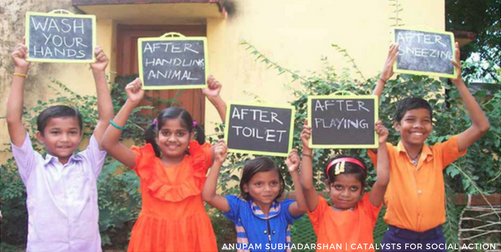
After we visit the toilet or cough or sneeze or touch child’s excreta or before we eat or touch other people’s hands or touch any surfaces, we must wash our hands under running water with soap. The soap helps to kill the disease-causing organisms we cannot see with our naked eyes, and the running water helps to remove the disease-causing organisms from hands. This 20seconds activity can help us save our lives from diseases that can cripple us and kill us, save us cost from spending unnecessary exorbitant treatment, and also increase our productivity.
To my fellow health care providers, WHO (2017) findings proved that every year, 300 million patients under our care are affected by health care-associated infections (Nosocomial Infections) globally. And some causes of these problems were associated with lack of hand washing practices at the bed side. The burden of this action leads to prolonged stay of patients at the hospital, astronomical additional costs for the patients, unnecessary deaths and others. WHO further posited that only 40% of health care providers practice good hand washing globally, this means that it is very alarming for our health systems. As health care providers, let wash our hands with soap under running water before patient contact, after body fluid exposure risk, after patient contact, before aseptic task and after contact with patient surroundings.
Education.
I know you are curious to know how hand washing has impact on education. I am also thinking same.
Hutton and Haller (2004) cited in globalhandwashing.org found out that children missed a cumulative of 272 million school days each year due to diarrhea associated with lack of hand washing. When hand washing with soap was instituted in the various schools, it was found to help reduce school absenteeism caused by diarrhoea, influenca and conjunctivitis by up to 50%.
Another interesting revelations which I don’t know where to put it are menstrual hygiene, hand hygiene and productivity. Findings by WaterAid, WSSCC and Unilever (2013) cited in globalhandwashing.org was that 80% of factory workers in Bangladesh who were young women, 60% of them used dirty rags from the factory floor as menstrual clothes to clean. And this led to 73% of the (60%) young women missing work for an average of 6days per month due to infections. When hand washing facilities were put in place at the various wash rooms such as soap, disposable tissue and adequate flow of water, only 3% of the young women absent themselves from work.
Economics.
The Lancet (2013) asserted that the annual net cost of diarrhoea and pneumonia in some developing countries incurred more than 12 billion dollars per year. Meanwhile, the estimated cost of national hand washing program would be less than 100million dollars and generate a revenue of 2-5 billion dollars. This means that investing into hand washing activities like ensuring adequate hand washing facilities, public education and policy development and implementation produces Return On Investment. Additionally, when the population practices good hand washing, it prevents unnecessary spread of infections like cholera, typhoid, pneumonia, COVID-19 and others which increases productivity and this boosts the economy. A healthy population is a healthy economy !
It is therefore imperative for us all to come together in our small way as an individual, groups, government and others to see and sustain hand washing as a habit to maximise the impact as a community, nation and the globe at large. We as parents, teachers, health professionals and others can teach our children, students, patients, church or mosque or traditional members how to wash our hands with soap, and the benefits. Kindly share this article to increase the sensitisation to sanitise the public as Bob Wine does say. Thank you.
Sources.
1. https://globalhandwashing.org


 Kwasi Omaro
Nice pice bro. Very educative. Thank you
LikeLiked by 1 person
Thanks.
LikeLike