
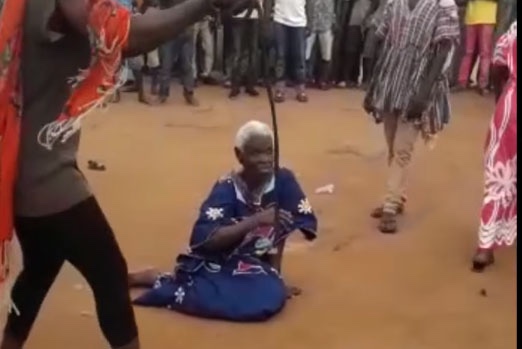
Personal experience of the author.
When I was Twelve (12) years, I visited my village at the Dormaa municipality called Nsesero with my mommy. There was a time I requested permission from my mommy to visit my grandmother(paternal) at the nearby village, Sokura, about 5km from Nsesero. My mommy whispered to me that my grandmother has been accused of witchcraft recently so should not get close to my grandmom but I refused. I murmured that your mommy (grandma-maternal) is not a “witch” but my dad’s mother is “witch”. As time goes on, psychologically, I became scared to get close to my grandma (paternal), and started withdrawing from her. Until I grew fourteen (14), I returned to my normal senses to get close to my grandma (paternal) because I learnt to understand old age in General Science, and this was reinforced in my nursing education where I did Gerontology ( study of old age), African studies ( where I did witchcraft as a topic). These educational trainings have changed the way I used to think about witchcraft and old age.
What the People Must Know.
Nana Ataa Ama (pseudo-name) is my grandma who is 100 years at Dormaa-Ahenkro, Sokura in the Bono region of Ghana. Nana Ataa Ama has gray hairs and bald hair which society sees unusual especially being a woman. She cannot easily recognise me as well as recollect present and past incidents easily. My grandma, Nana Ataa Ama has loss sense of smell and taste. She cannot see nor hear well.
This wonderful grandma always feels guilty, hopeless and inactive as well as having burning sensations on her body sometimes as if she has rashes. All these are signs and symptoms of old age, never associate them with witchcraft. Everyone is likely to experience these things when growing old. Ageing is progressive, ubiquitous and inevitable to all living things. Kindly empathise with the old people and treat them (aged) the way you want to be treated. As the Holy Bible says Do unto others what you want others to do unto you.
It was observed that as Nana Ataa Ama ages, her whole body became small in size due to the muscles wearing off, and reduced in height. She sweats a lot like ‘the pregnant fish’ during the night. Lol! Nana Ataa Ama does not urinate excessively like grand pa. Her skin is very dry with weak bones so we always ensure enhanced safety for her to prevent fracture from falls. Nana Ataa Ama is able to tell us stories which are documented although there is distortion in her thinking. Grandma Nana Ataa Ama cannot stand straight but shifted to one side of her body. Another key feature of old people observed from Nana Ataa Ama was that her skin has uneven colour in areas like the lips, face, neck, upper chest and back of her hands, which the science community called photoaging. It can be deduced that Ageing is biological and social construct. One goes through some changes as one grows which is a natural process.

Photo credit; plastic surgery.com
Lastly, not every woman can marry at early age nor marry at all. It’s not the woman’s fault nor anyone’s fault if she has not married. It’s not her fault if the husband has died, making her a window nor the fault of anyone. Everything that happens is the will of God so society must understand and accept women the way they are. Everyone can be victim so as you judge now, think that you will the one to be judged the next time.
What benefit do we get from our old people?
1. We get oral tradition from them ( history).
2. Our Old people use their experience, knowledge and wisdom to resolve family/community and conflicts. My Grandpa is 100years plus and still playing this role in my wonderful village.
3. Our old people are the custodians of welfare of family.
Flashback.
The accused of gender related witchcraft is a huge challenge in Sub-Sahara Africa. Anyone who suffers sickness, bad luck or unfit to control his or her own destiny associate these to witchcraft psychologically. During the colonial era, witchcraft related functions were inhibited because it was thought to retrogress development, but this has reappeared in the 20th century in a form of exorcistic functions known in Churches as “Deliverance” and traditional world as “anti-witchcraft shrine”. However, it seems the story has still not changed in this 21st century, the concept of witchcraft has now shifted from traditional to modernity.
According to United Nations Office on Drugs and Crime (UNODC) (2018), one of the major cause of gender-related killing of women and girls is killings of women as a result of witchcraft accusation. Women in our society faced increasing risk as they approach old age because as said by Prof. Dzodzi Tsikata ( Development Sociologist, University of Ghana) cited in ActionAid (2012) that when society thinks these elderly women are no more useful, and are not conforming to what society expect, these elderly women become targets ( vulnerable). These women are threatened, fled discrimination and sometimes lynched to death after being accused as witch, and blamed for one’s sickness or curse or even just appearing in someone’s dream. For instance, in November, 2010, a 72 year old Ama Hammah at Tema, was set ablaze by five adults, with one of them believed to be a pastor after being accused of witch, and tortured to accept that accusation. Also, the recent one at Kafaba, East Gonja in the Savannah region of Ghana on Thursday, July 23rd, 2020 where a 90 year old Akua Denteh was lynched to death after being accused of witchcraft and the cause of the community’s sufferings.
PhotoCredit: modernghana.com
According to ActionAid (2012), over 3,000 women in Ghana especially Northern belt are accused of witchcraft. Some of these ‘lucky’ accused witches may reach the witch camp. These women are ‘lucky’ because others who are accused are lynched or burned to death instantly without being heard ( mob justice). Now, do we maintain these so call witch camps to protect the life of accused witches or disband them? I am sure your guess is as good as mine. There are Seven (7) witch camps in the Northern part of Ghana. These include Gambaga, Kukuo, Gnani, Bonyase, Nabuli, Gushiegu and Kpatinga. All these camps are remote areas, very far from the main community, with inadequate food and water, making life inhabitable. These camps are made up of mud huts with flimsy thatched roofs, with little or no hope of normal life to these vulnerable women ( accused of witchcraft).
Old men are not excluded from these witchcraft accusations but the most commonest and majority is elderly women. The only advantage of accused wizards over accused witches is that some men are economically independent and have the strength to resist such human rights violence. What criteria do the people use to accuse these old women as witches? Any woman who is unable to fulfil expected gender stereotypes like widows, unmarried or cannot have children or behave strangely from what society expects then you’re branded as witch.
The Issues.
Deep Rooted Beliefs: Most society perceived that the natural environment is controlled by spiritual forces, hence anything that happens has spiritual relation which can only be controlled be sooth sayers/ fetish priest(priestess). For example; Akosua (pseudo-name) has severe abdominal pain, and may spiritualise her sickness but do not think it is physiological imbalance. These members of society believe that performing charms & rituals is the answer to any calamity. These people use avenues like families, chiefs and the shrines to perform these ritual activities.
Ignorance; Most community folks do not know the associated ageing issues, hence anyone seen behaving or showing signs that the community thinks is abnormal is associated with witchcraft. Moreover, most people perceived that at certain stage, a woman must marry, give birth and others. The strange weird issue is some people do not understand why that woman’s brothers or sisters will die, and she (accused witch) is alive and even grow old or very old.
Stereotyped Roles females play in film; Commonly, it is women who are given the role of acting as a “witch” in most African movies than men, and this affirms the perception society has for women.
The Gendered media; Media is permeating and very powerful. Media representation of men is that men are culturally standard but women are unimportant or invisible.
Failed System; Ghana’s constitution talks about rights of citizens, yet, these vulnerable alleged witches are dying inhumanly. Ghana has signed so many conventions like Convention on the Elimination of All forms of Discrimination against Women (CEDAW), African Charter on Human and Peoples’ Rights (ACHPR) and others as well as systems such as Commission On Human Rights & Administrative Justice (CHRAJ), Domestic Violence and Victim Support Unit (DOVVSU) to enforce the law, then National Commission for Civic Education (NCCE) to sensitize the public, including policy document; National Gender Policy 2015 to protect the human rights and empower women are in place but there are still uprising witchcraft-related femicides in the country. The question you and I will ask is “why?”. The answer is simple; the state has not prioritize this area and ensure the systems work.
The Way Forward.
Community-based Social Marketing Sensitization; This is where you dialogue with community leaders and community folks to understand them from their point of view ( Emic perspective), and establish common ground for the sensitization process. This approach will help to end accusation and killing of alleged witches because everyone is involved in the process.
Other stakeholders’ engagements ; After the community engagement, it is imperative Ministry of Gender, Children and Social Protection collaborate with NCCE, HelpAge Ghana, Creative and Art Industry, CHRAJ, faith-based organisations, non-governmental organizations like ActionAid, National Media Commission and the media in the fight against witchcraft-related femicides.
NCCE together with HelpAge can get an expert in gerontology to help with message on old age and its associated issues to sensitize the community.
The Creative and Art Industry will help to avoid the stereotyped roles females play in movies/films.
There should be a dialogue with Faith-Based organisations like churches, mosques, shrines and others about their beliefs to reach a common ground to end witchcraft-related femicides.
The National Media Commission should be charged to monitor and validate gender appropriate media content programs.
The media should be engaged in terms of how it represents women in the media.
Passage of the Aged Bill into Law; Some of the findings of some researchers especially F.A. Agyemang (n.d) showed there is inadequate legal support for the aged, hence the need to pass the aged bill which has been at parliament since 2010. However, others like Kofi Bentil ( Vice President of Imani Centre for Education and Policy) thinks it is a system failure, hence the systems should be activated and function well. For instance, the police service, DOVVSU, CHRAJ and others should be well resourced and functional.
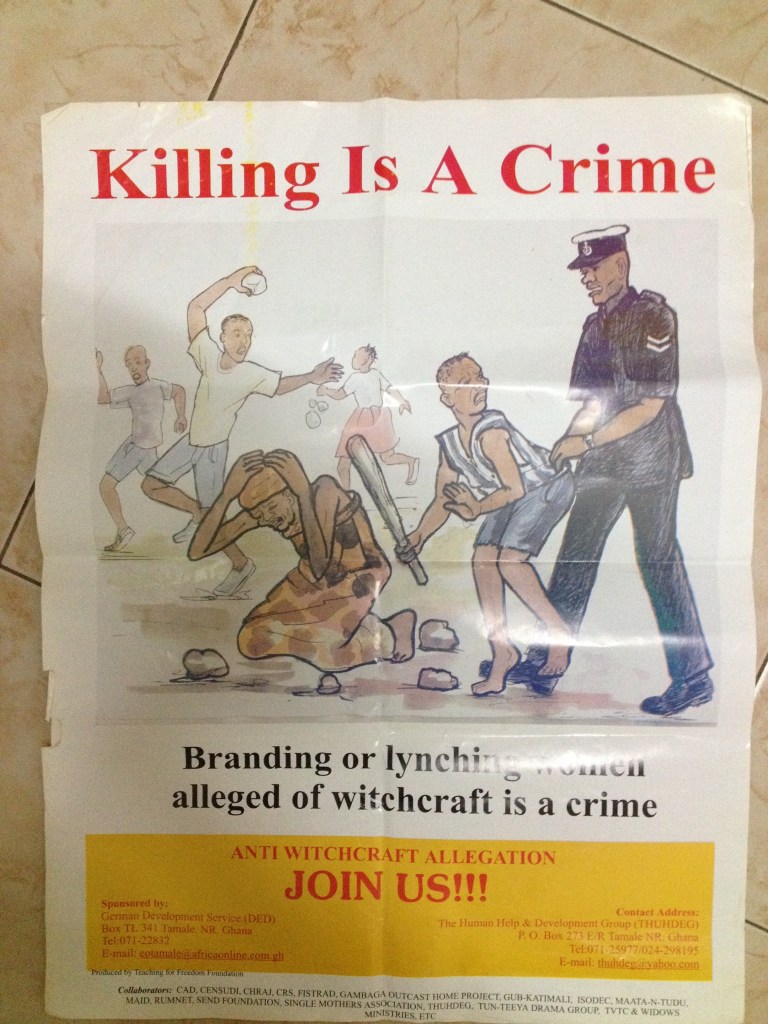
Old age is not an offense to be branded as a “witch” but a normal natural process.
It is not the fault of old women to behave ‘strangely’ as perceived by society but an inevitable process.

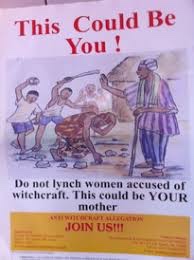
Everyone is likely to grow old, hence another time, it might be you or your sister or wife or mother or daughter who will be alleged as witch. It is therefore prudent to speak up against this witchcraft-related femicides. Say something if you see something! Kindly share with a friend to share with a friend to be part of anti witchcraft campaign or tell a friend to tell a friend to sensitize the youth against witchcraft and its related issues on women. Women’s life matter!
Sources.
1. http://www.pctii.org>cyberj10>onyinah
2. https://www.alz.co.uk>filespdf
3. https://www.unodc.org>gah PDF
4. https://www.actionaid.org.uk>…pdf
5. https://www1.udel.edu>Gen…pdf
6. https://www.mogcsp.gov.gh>national
7. https://VC.bridgew.edu>chi pdf
8. https://epub.uni-bayreuth.de>…pdf
9. https://fhs.mcmaster.ca>docspdf
10. https://www.chr.up.ac.za>filespdf


Fantastic bro, keep it up. Keep educating us. Very interested article.
LikeLiked by 1 person
Thanks bro.
LikeLike