
It’s never too early or too late to start looking after your mouth: your body will thank you.
FDI World Dental Federation
Every 20th March marks the #WorldOralHealthDay, an initiative of the FDI World Dental Federation to bring together the world of dentistry to achieve optimal oral health for all. The World Oral Health Day celebration helps to empower people with the knowledge, instruments, and assurance to ensure good oral health. 20th March was chosen because studies indicated that seniors must have a total of 20 natural teeth at the end of their life to be considered healthy. Also, children should have 20 baby teeth, then healthy adults must have a total of 32 teeth and 0 dental cavities which can be expressed as numerically as 3/20.
Oral diseases are major health problems in many countries due to their negative impacts on people’s lives like pain, discomfort, social isolation, loss of self-confidence, disfigurement, and even death. These negative impacts also affect the health systems as well as the economy of the country at large. For that matter, the World Oral Health Day celebration helps to unite the world to reduce the burden of these oral diseases.
Meanwhile, most of these oral diseases as a major concern in many countries are largely preventable and can be treated in their early stages but are expensive. Therefore, this article will enlighten you, briefly on some common oral diseases, their causes, and/or risk factors, and preventive measures to promote oral health. This leads us to this year’s theme for the World Oral Health Day celebration Be Proud of Your Mouth. This means that we must value and take care of our mouths. To do this, we must know about oral health.
World Health Organisation’s (WHO) Global Oral Health Status Report (2022) and Global Burden of Disease (2019) estimated that oral diseases affect nearly 3.5 billion people, with untreated dental caries (tooth decay) in permanent teeth most common oral disease. Other oral diseases include; gum disease (periodontal), total tooth loss (edentulism), oral cancer, and mouth and teeth (oro-dental) trauma.
Modifiable Factors that can put one at risk of getting oral diseases mentioned above include sugar consumption, tobacco use, alcohol use, poor oral hygiene, diabetes, immunocompromised persons, inadequate exposure to fluoride-containing toothpaste, and poor access to oral health care services.
Dental caries (tooth decay) is when plaque forms on the surface of the tooth. This is a result of a high intake of free sugars from food and inadequate exposure to fluoride as well as a lack of removal of plaque by tooth brushing. Germs then convert these free sugars into acids that destroy the tooth over time, leading to caries, pain and sometimes loss of tooth and infection.
Gum (periodontal) disease affects tissues surrounding the teeth, leading to gum bleeding, swollen gums (gingivitis), pain and sometimes bad breath as a result of poor oral hygiene, tobacco use, diabetes, obesity.
Total tooth loss (edentulism) can be a result of a lifelong history of oral disease or trauma or others.
Oral cancers can occur on the lips, mouth abd/or throat. This is more in men and older people. There is a growing percentage of oral cancers among young people as a result of the Human Papillomavirus (HPV) which may be from oral sex.
Trauma to mouth and teeth as a result of injury to teeth, mouth and oral cavity, brought about by lack of alignment of teeth, or factors like unsafe playgrounds, road traffic accidents, violence and others.
Noma is when the mouth and face become severely gangrene as a result of malnutrition, infectious diseases, poverty, weakened immune system, and others. This often starts as sore gums, with swollen gums and dead tissues, and spreads to the face. This oral disease usually affects children between 2-6years old.
We can prevent these oral diseases by practicing the following.
1. Eat a well-balanced diet, with low sugar intake but high fruit and vegetable intake. It mostly said if you want to live healthily, eat like a goat and that’s very accurate.
2. Avoid tobacco use, including areca nuts.

3. Reduce alcohol intake
4. Twice daily tooth brushing with fluoride-containing tooth paste.
5. Frequent mouth rinsing with water or salt water (warm saline).
6. Use of protective equipment during sporting activities, bicycle or motorcycle riding to reduce facial injuries.
7. Avoid using your teeth as openers for bottles.
8. Exercise your jaws by taking sugar cane, and chewing gum.
9. Avoid eating too hot or too cold food
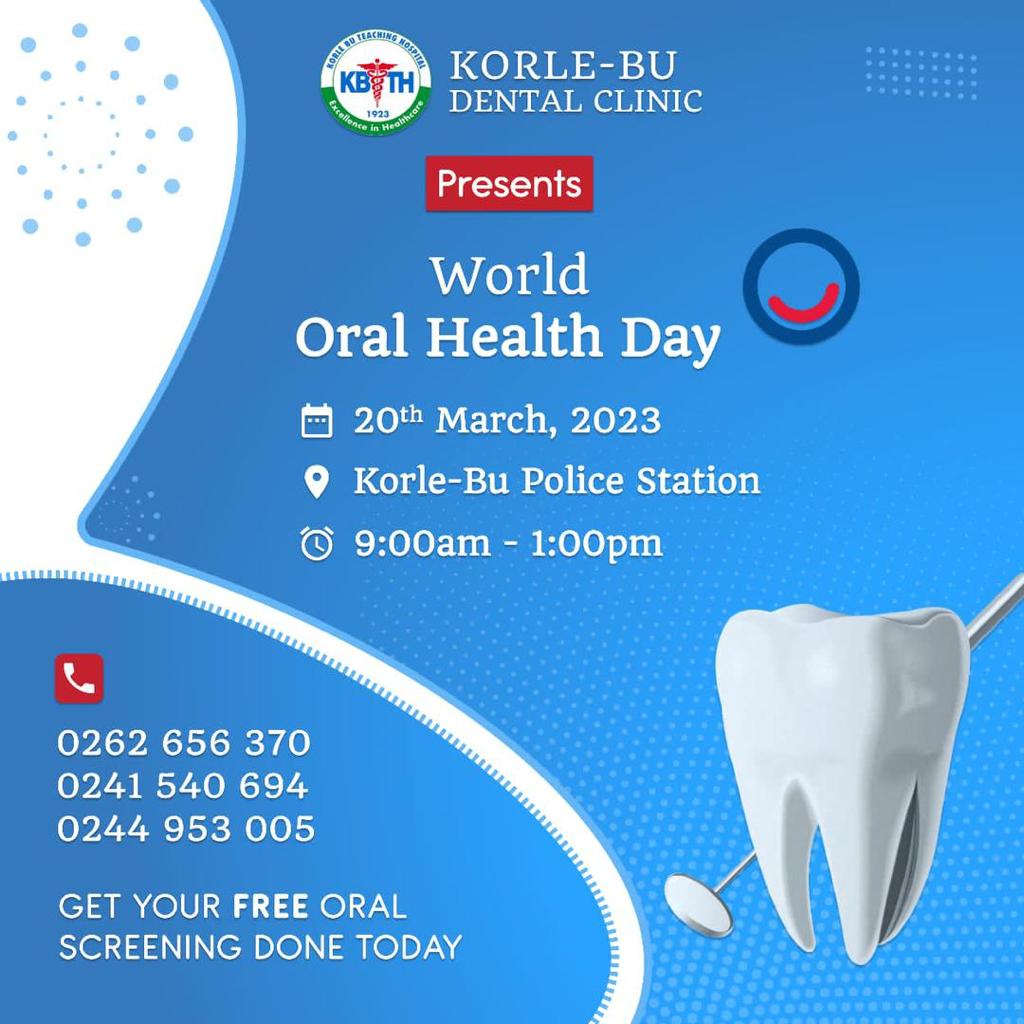
10. Visiting the dentist at least twice a year. I will therefore urge you all to take this advantage to be part of the oral health screening scheduled on Monday, 20th March at Korle-Bu Police station organized by Korle-Bu Dental clinic. Below is the poster for your attention.
Let’s have in mind that our mouth is a mirror reflection of our general well-being, therefore we must take good care of our mouth because every smile counts! #WorldOralHealthDay #MouthProud #WOHD23
Credits:
https://www.fdiworlddental.org
 Kwasi Omaro