
World Health Organisation (WHO) reported that 38.4 million people living with HIV at the end of 2021. Out of this number, 25.6 million people with HIV are in Africa, this means two third of the population living with HIV are in Africa. It was also noted from WHO report that HIV/AIDS has claimed 40.1 million lives so far. This justified why HIV/AIDS is still a major global public health issue. In Ghana, since HIV was identified in 1986, Ghana AIDS Commission reported 346, 120 people living with HIV, with most being females representing 66%. Before we continue the conversation, let us have a brief history of HIV/AIDS in the subsequent paragraph.
Evidence revealed that HIV originated from Chimpanzees in Central Africa in the late 1800s. While in Chimpanzees, the virus was called Simian Immunodeficiency Virus but in humans, the virus is known as Human Immunodeficiency Virus (HIV). It was reported that the virus was passed to humans when humans hunted this Chimpanzee for meat and came in contact with their infected blood. Studies indicated that AIDS was first seen in homosexual men in the United States in 1981, hence scientists labeled this disease as gay-related immune deficiency, gay cancer, or community-acquired immune dysfunction in 1982. But HIV as the causative agent had been identified in 1983, and by the mid-1980s, this disease has largely spread unnoticed throughout the world. Findings suggest that 47% of all new HIV infections are among gay men, sex workers, people who inject drugs, transgender people, and prisoners.
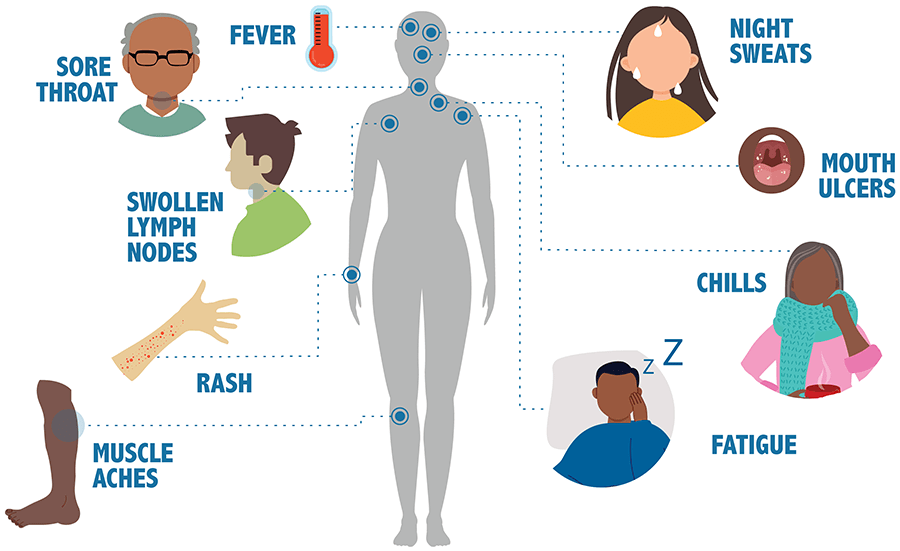
One may experience two or more of the following if infected with HIV
One of the best ways to prevent HIV is abstinence but if you cannot then it must be on when in. Check the expiry date when you buy one and keep it a room temperature. There are two main types of condoms. These are condoms used externally or male condoms and condoms used internally or female condoms. Always ensure it is on before in, either the man puts it on or the woman puts it on…….both cannot put the condoms on during sexual intercourse. Latex condoms provide the best protection against HIV, however, those with latex allergies can opt for plastic or synthetic rubber condoms. The only disadvantage of plastic or synthetic rubber condoms is that it breaks more often during sexual intercourse. Below is how to put it on before in because if it’s not on, it’s not in to protect you from HIV and other sexually transmitted diseases like Gonnorhoea as well as unwanted pregnancy.
How to put on the male condom
1. Carefully open and remove the condom from the wrapper.
2. Place the condom on the tip of the hard penis.
3. If uncircumcised, pull back the foreskin first.
4. Pinch the air out of the tip of the condom.
5. While holding the tip, unroll the condom down the penis.
6. After sex but before pulling out, hold the bottom of the condom and carefully pull out the penis.
7. Carefully remove the condom and throw it in the trash.
8. If you feel the condom break at any time during sex, stop immediately, pull out the penis, take off the broken condom, and put on a new condom.
9. Use water-based or silicone-based lubricants during sex to help keep the condom from tearing.
10. Don’t use oil-based lubricants because they can weaken the condom and cause it to break.
How to put on a female condom.
1. Carefully open and remove the condom from the package.
2. While holding the condom at the closed end, squeeze the sides of the inner ring together and insert them into the vagina or anus.
3. Use your finger to push the inner ring up until it rests against the cervix in the vagina or as far into the anus as it can go. Be sure the condom is not twisted.
4. The thin, outer ring should remain outside the vagina or anus.
5. Guide your partner’s penis into the opening of the condom.
6. After sex, gently twist the outer ring and pull the condom out.
7. Carefully throw the condom in the trash after using it one time.
8. Stop intercourse if you feel the penis slip between the condom and the walls of the vagina/anus or if the outer ring is pushed into the vagina/anus.
9. Use lubricant during sex to help keep the condom from slipping or tearing. It is safe to use any lubricant with an internal condom.
Always do remember that if it’s not on, it’s not in.
My valued and cherish reader, I was adding to my scientific knowledge. This explains why a year now, you are seeing my write-up again. Kindly watch out for more fascinating write-ups and health jokes videos. Thanks for being part of the success story always. I love you all.
Credits:
https://www.cdc.gov/hiv/basics/hiv-prevention/condoms


 Kwasi Omaro
Good job senior
LikeLiked by 1 person
Well done Kwasi🙏🙏
LikeLiked by 1 person